
How to Find the Right B2B Influencer for Your Brand
Learn how to find and vet B2B influencers who match your brand values, audience, and goals. Discover the key criteria that drive real marketing results.

How to Find the Right B2B Influencer for Your Brand
B2B buyers trust peer recommendations over brand advertising, yet most influencer partnerships fail before they begin. Why? Brands choose creators based on follower counts rather than audience quality. According to research, 53% of B2B marketers report dedicated B2B influencer marketing budgets that continue to grow, yet identifying and connecting with the right influencers remains their biggest challenge.
The solution isn't finding creators with impressive metrics, it's finding those who actually reach your target accounts with credibility and influence. If you're still building the business case, our guide to what B2B influencer marketing is and how it works covers the fundamentals.
Why B2B Influencer Selection Differs from Consumer Marketing
Consumer influencer marketing rewards reach. B2B influencer marketing rewards precision. Lifestyle brands bet on volume: millions of impressions and a small percentage of conversions. B2B doesn't work that way.
B2B buyers are sceptical, research-driven professionals who make decisions over months, not minutes. They trust peers who understand their challenges, not personalities with large followings. A LinkedIn thought leader with 8,000 followers who speaks directly to enterprise CTOs often influences more pipeline than a generalist business creator with 200,000 followers.
This difference shapes how B2B brands source creators. The process starts with clear goals, then identifying niche experts on platforms like LinkedIn or within industry communities. Credibility and relevance matter more than scale.
The shift towards B2B influencer marketing is accelerating. According to TopRank Marketing's 2025 B2B Influencer Marketing Report, 99% of B2B marketers using an always-on approach to influencer marketing rate their programmes as effective, while 72% of the most advanced teams now have a dedicated influencer budget they expect to grow this year. This data underscores why precision in influencer selection matters: programmes built on the right partnerships consistently outperform those focused solely on reach.
Learn how Flooencer connects B2B brands with vetted industry experts. Book a call to discuss your influencer strategy.
Step 1: Identify What Makes a B2B Influencer Effective for Your Brand
Before you search, define what "effective" means for your objectives. B2B influencers share three characteristics that separate them from generic business creators:
- Genuine professional expertise: They've done the work. Former practitioners, current operators, or recognised specialists who can speak credibly about the challenges your buyers face. Their authority comes from experience, not just content creation skills.
- Audience composition that matches your ICP: Their followers include the job titles, industries, and company sizes you're targeting. A creator might have impressive engagement, but if their audience is primarily students or early-career professionals, they won't move enterprise deals.
- Content that sparks meaningful discussion: Look at the comments. Are people asking thoughtful questions? Sharing their own experiences? Tagging colleagues? This signals an engaged community that trusts the creator's perspective.
Step 2: Source B2B Influencers Across Multiple Platforms
B2B influence is fragmented across multiple channels. This makes sourcing more complex, but it also creates opportunities to find creators your competitors miss. Each platform serves different purposes:
- LinkedIn: Best for thought leadership and executive audiences. Prioritise engagement quality and follower seniority over connection counts.
- YouTube: Ideal for educational content and product demonstrations. Evaluate watch time, subscriber growth, and comment depth.
- Podcasts: Perfect for long-form expertise and niche communities. Review download numbers, guest quality, and listener demographics.
- Newsletters: Provide direct audience access with high-intent readers. Check open rates, subscriber counts, and reply engagement.
- Industry communities: Offer niche expertise and practitioner credibility. Assess reputation within the community and contribution quality.
Platform-Specific Discovery Tactic: LinkedIn
When searching LinkedIn for potential influencers, use the platform's native search with precise job titles rather than generic keywords. Search for "VP of Marketing" or "Head of Sales Enablement" combined with active posting indicators like "Creator" or "Top Voice." Filter results by location to match your target markets, then review their recent posts for engagement quality. Look for creators whose content generates 50+ substantive comments from other senior professionals, this signals genuine influence amongst decision-makers, not just passive followers.
Start with LinkedIn, where most B2B decision-makers spend time. Then expand to podcasts and newsletters, creators on these channels often have smaller but highly engaged audiences. A newsletter with 5,000 subscribers who open every issue can outperform a social account with 50,000 passive followers.
Don't overlook your existing network. Customers, partners, and employees sometimes have influence you haven't recognised.
Step 3: Evaluate Influencer Audience Quality Over Quantity
Follower counts tell you almost nothing useful in B2B. What matters is whether the creator's audience includes people who can actually buy your product.
Analyse engagement patterns. High-quality B2B audiences leave substantive comments, share posts with their own commentary, and tag colleagues. Low-quality audiences leave generic responses or no engagement despite large follower numbers. Examine who's engaging. Click through to the profiles of people commenting and sharing. Do they hold relevant job titles? Work at companies in your target market? If a creator's most engaged followers are marketers but you're selling to CFOs, the audience fit isn't there.
Request audience demographics directly. Ask creators about their audience composition. Serious business influencers track this data and can share insights about follower seniority, industry breakdown, and geographic distribution.
The data support this quality-over-quantity approach. B2B campaigns with micro-influencers (10,000–50,000 followers) generate an average engagement rate of 5.7%, whilst macro-influencers (500,000+ followers) average just 1.8%. More importantly, B2B campaigns see an average lead conversion rate of 3.4%, compared to 1.9% for B2C when measuring qualified leads. These metrics demonstrate that in B2B, smaller audiences with genuine professional interest consistently deliver better business outcomes than large, general followings. ( 150+ Influencer Marketing Statistics to Guide Your 2025 Campaigns)
Pro Tip: Request a sample of the creator's audience data before committing to a partnership. Reputable B2B influencers maintain analytics on their follower composition and can share anonymised breakdowns.
Step 4: Assess Content Quality and Brand Alignment
Content quality means substance and perspective that resonates with sophisticated buyers. Review 20–30 recent posts: Are they sharing original insights? Taking positions on debates? Explaining complexity clearly?
Brand alignment requires examining values, not just topics. A creator might cover relevant subjects but approach them in ways that conflict with your brand positioning. Check their partnership history: How have they integrated other brands? Does it feel natural or forced?
Watch for red flags:
- Inconsistent posting: Long gaps suggest unreliable delivery
- Engagement that doesn't match follower count: Could indicate purchased followers
- Generic content: Suggests lack of depth to speak credibly to your audience
- Controversial positions unrelated to business: May create brand risk
Step 5: Approach and Build Relationships with B2B Creators
Cold outreach works, but warm introductions work better. Engage authentically with the creator's content first. Comment thoughtfully on their posts and share their work with your own perspective added.
When you reach out, lead with specificity. Explain exactly why there's a fit: which posts resonated, how their audience aligns with yours, and what collaboration you're envisioning. Be transparent about your goals and budget range; our complete guide to B2B influencer campaign costs will help you set realistic expectations before that conversation.
Consider starting with a smaller collaboration before committing to a larger campaign. A single sponsored post or podcast appearance lets both sides evaluate the fit before investing heavily.
For instance, collaboration platform Miro partnered with productivity influencers to showcase user-created templates through tutorial content. The campaign expanded its reach beyond traditional SEO channels, driving qualified traffic from engaged professional audiences who trusted the creators' recommendations. (Top 32 B2B Influencer Marketing Agencies [2025 Review])
The best B2B influencer relationships develop over time. One-off sponsorships rarely deliver the results that ongoing partnerships produce. When a creator mentions your brand repeatedly over months, their audience begins to associate you with the creator's credibility.
Common Mistakes When Selecting B2B Influencers (And How to Avoid Them)
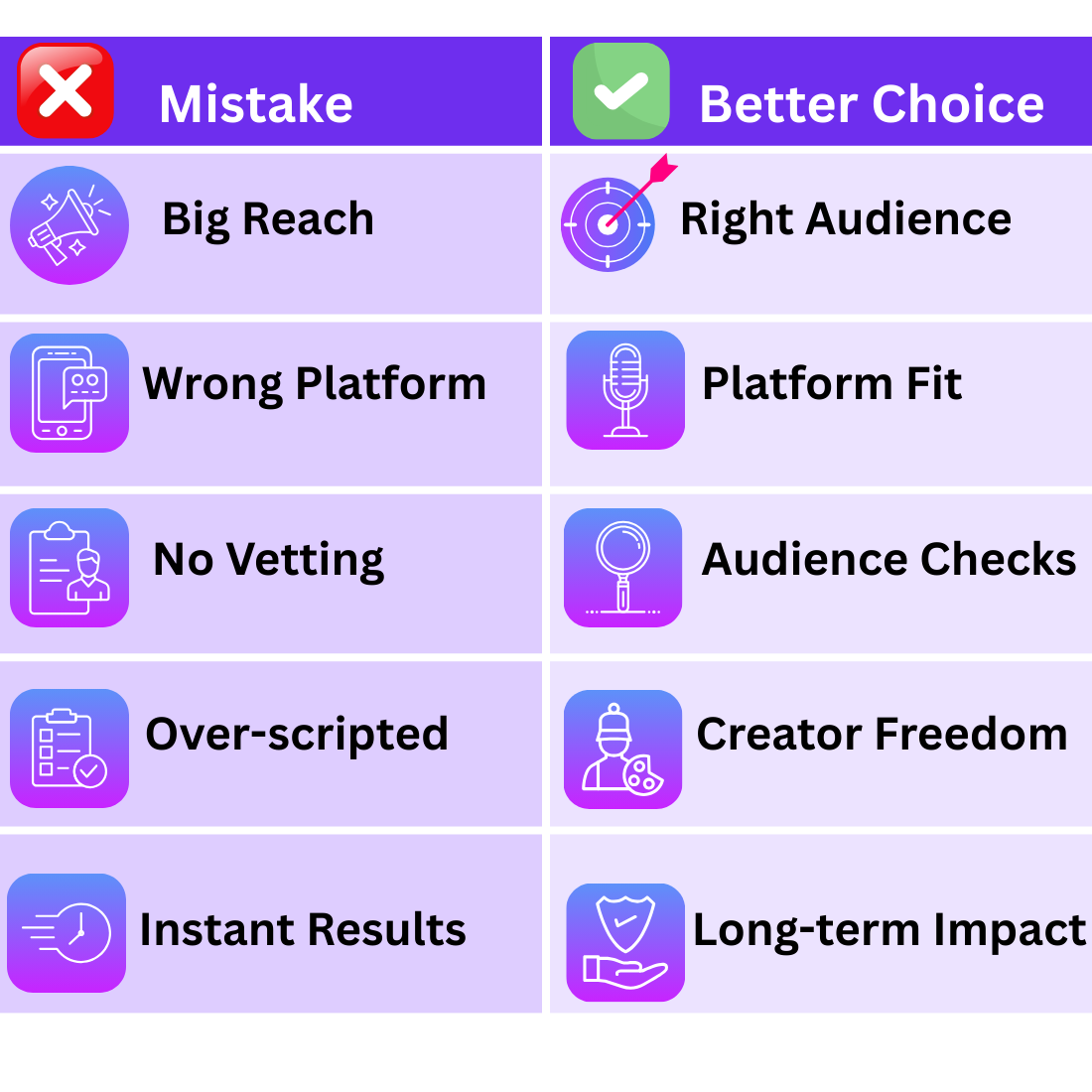
Mistake 1: Prioritising reach over relevance. A creator with 500,000 followers sounds impressive until you realise only 2% work in your target industry.
Solution: Prioritise smaller, highly targeted audiences over large, generic followings.
Mistake 2: Ignoring platform fit. Different platforms serve different purposes. LinkedIn works for awareness and thought leadership. Podcasts work for deep education. Newsletters work for direct response.
Solution: Match the platform to your campaign goals, not follower counts.
Mistake 3: Skipping the vetting process. Enthusiasm about a creator's content isn't the same as confirming audience fit.
Solution: Always verify audience composition through data requests and profile checks before committing budget.
Mistake 4: Treating influencer marketing like advertising. B2B influencer partnerships work because they feel authentic. Over-scripted content and aggressive CTAs undermine trust.
Solution: Give creators creative freedom within brand guidelines and focus on education, not selling.
Mistake 5: Expecting immediate results. B2B sales cycles are long. Influencer content builds awareness and credibility that compounds over time.
Solution: Measure success through multiple touchpoints over several months, not single posts.
How to Measure B2B Influencer Partnership Success
Attribution in B2B influencer marketing is genuinely difficult. Six-month sales cycles and multi-touch buying journeys make clean measurement challenging. Track these meaningful signals:
- Engagement metrics: Track quality of engagement. Are target accounts interacting? Are decision-makers sharing the content?
- Traffic and conversion: Use UTM parameters and dedicated landing pages to track website visits and form fills from influencer content.
- Pipeline influence: Work with your sales team to identify deals where influencer content appeared in the buyer's journey.
- Brand lift: Survey your target audience before and after campaigns to measure changes in awareness and consideration.
- Direct feedback: Ask prospects how they heard about you. "I saw you mentioned on [creator's] podcast" is a valuable signal.
The most honest approach combines quantitative tracking with qualitative assessment. For a deeper look at which metrics to prioritise at each stage of the funnel, explore our guide to business influencer marketing KPIs.
Why Working with a B2B-Focused Partner Accelerates Results
Finding, vetting, and managing B2B influencer relationships takes significant time. A specialised partner brings established creator relationships, vetting processes that filter for audience quality, and campaign management experience that prevents common mistakes.
At Flooencer, we've spent 28+ months building a vetted network of 2,000+ business creators across LinkedIn, YouTube, podcasts, and niche B2B communities. We source creators based on audience composition and ICP fit, not follower counts. Our campaigns for FTSE 100 companies and venture-backed tech brands have consistently delivered measurable pipeline influence.
For teams with limited bandwidth or those scaling B2B influencer marketing programmes, partnering accelerates results.
Key Takeaways: Finding the Right B2B Influencer
- B2B influencer selection prioritises precision over reach; smaller, targeted audiences consistently outperform large, generic ones
- Effective influencers demonstrate genuine expertise, audience alignment with your ICP, and content that sparks meaningful discussion
- Source across multiple platforms, including LinkedIn, YouTube, podcasts, newsletters, and industry communities
- Evaluate audience quality through engagement patterns, follower demographics, and direct data requests
- Avoid common mistakes like prioritising reach, skipping vetting, and expecting immediate results
The influencer discovery process takes time, but the investment pays dividends when you find creators whose audiences trust their recommendations and whose values align with your brand.
Book a call with Flooencer to discuss your B2B influencer marketing campaign and access our vetted network of industry experts.
Commonly asked questions from this article
There's no ideal follower count for a B2B influencer. Follower count matters far less than audience relevance in B2B. A creator with 5,000 highly engaged followers from your target industry will typically deliver better results than one with 100,000 generic business followers. Focus on:
- What percentage of their audience matches your ICP
- Engagement quality (substantive comments, meaningful discussions)
- The seniority and decision-making authority of engaged followers
To verify an influencer’s audience quality you should: request demographic data directly from the creator, including industry breakdown, job title distribution, and geographic location. Reputable B2B influencers track these metrics. Additionally:
- Manually review profiles of recent commenters and sharers
- Analyse engagement patterns; substantive comments indicate quality audiences
- Check if engagement rate aligns with follower count (low engagement relative to followers may indicate purchased followers)
For most B2B campaigns, working with multiple micro-influencers (5,000–20,000 followers) delivers better results than a single macro-influencer. Benefits include:
- Greater combined reach across different audience segments
- More authentic, trusted voices versus a single celebrity endorsement
- Lower risk; if one partnership underperforms, others can still succeed
- Often more cost-effective with better engagement rates
B2B influencer marketing builds momentum over time rather than delivering instant results. Expect:
- Immediate impact: Increased website traffic, content engagement, and social mentions within the first month
- Medium-term results (3–6 months): Growth in qualified leads, meeting requests, and pipeline influence
- Long-term impact (6+ months): Improved brand perception, shortened sales cycles, and higher close rates as credibility compounds
The reasonable budget for B2B influencer partnerships vary widely based on expertise, audience size, and content format:
- Micro-influencers (5,000–20,000 followers): $650–$3,900 per content piece
- Mid-tier influencers (20,000–100,000 followers): $3,900–$13,000 per content piece
- Established experts (100,000+ followers or recognised industry authorities): $13,000+ per campaign, often structured as ongoing partnerships
Budget $2,600–$6,500 per month for meaningful B2B influencer programmes, working with 2–4 creators on ongoing campaigns rather than one-off posts.
Read more

26 Feb 2026
What Is B2B Influencer Marketing: Guide for 2026
Learn how to build a winning B2B influencer marketing strategy. 86% of B2B brands report success. Discover the framework to join them.

26 Feb 2026
Find Leading Tech Influencers for Your B2B Brand
Discover how to find, evaluate, and partner with B2B tech influencers who actually reach your target buyers and decision-makers
26 Feb 2026
Business Influencer Marketing KPIs: A Complete Guide
Key influencer marketing KPIs to measure performance, ROI, and business impact.