
Find Leading Tech Influencers for Your B2B Brand
Discover how to find, evaluate, and partner with B2B tech influencers who actually reach your target buyers and decision-makers

Find Leading Tech Influencers for Your B2B Brand
B2B influencer marketing isn't about renting attention for a week. It's about building influence over time through relationships with credible voices in your industry. When you do it right, buyers show up to sales calls already educated, and deals close faster because trust has been pre-built.", Tom Augenthaler, B2B Influencer Marketing Strategist
Finding tech influencers is straightforward. Finding tech influencers who actually reach your target buyers is where most B2B influencer marketing programmes get stuck.
The creator with millions of YouTube subscribers reviewing smartphones won't help you reach enterprise CTOs evaluating your security platform. This guide covers how to identify, evaluate, and partner with technology influencers who hold genuine influence over the decision-makers you're trying to reach.
What Are Technology Influencers
Technology influencers are creators who build audiences around tech topics and hold credibility with buyers making purchasing decisions. If you're new to the discipline, our guide to what B2B influencer marketing is and how it works covers the fundamentals.
While consumer tech creators like Marques Brownlee (MKBHD) have built massive followings reviewing gadgets, B2B brands need a different type of creator entirely. B2B tech influencers (practitioners discussing SaaS platforms, cloud infrastructure, and enterprise software), operate differently. Most B2B brands discover these creators through LinkedIn searches, industry event speakers, podcast guests, or platforms like Collabstr and Klear that include B2B creator filters.
Here's the distinction that matters for B2B brands, though. Consumer tech influencers review smartphones and gadgets for general audiences. B2B technology influencers discuss enterprise software, SaaS platforms, and business technology topics that reach CTOs, VPs of Engineering, and buying committees.
The creator reviewing the latest iPhone won't help you reach enterprise decision-makers evaluating your security platform.
Types of Tech Influencers to Consider
The right type of influencer depends entirely on your campaign goals and who you're trying to reach.
Enterprise and B2B Technology Influencers
Business influencers discuss enterprise software, cloud infrastructure, cybersecurity, and SaaS topics. Their audiences include CTOs, IT directors, and professionals who influence purchasing decisions at companies.
They typically operate on LinkedIn, podcasts, and YouTube, with smaller but highly targeted followings.
Technology Micro Influencers
Micro influencers have smaller audiences, typically under 50,000 followers, but often deliver higher engagement rates and more targeted reach.
A micro influencer with 8,000 followers who speaks directly to DevOps engineers can outperform a generalist with 500,000 followers for a developer tools company.
Where to Find Tech Influencers by Platform
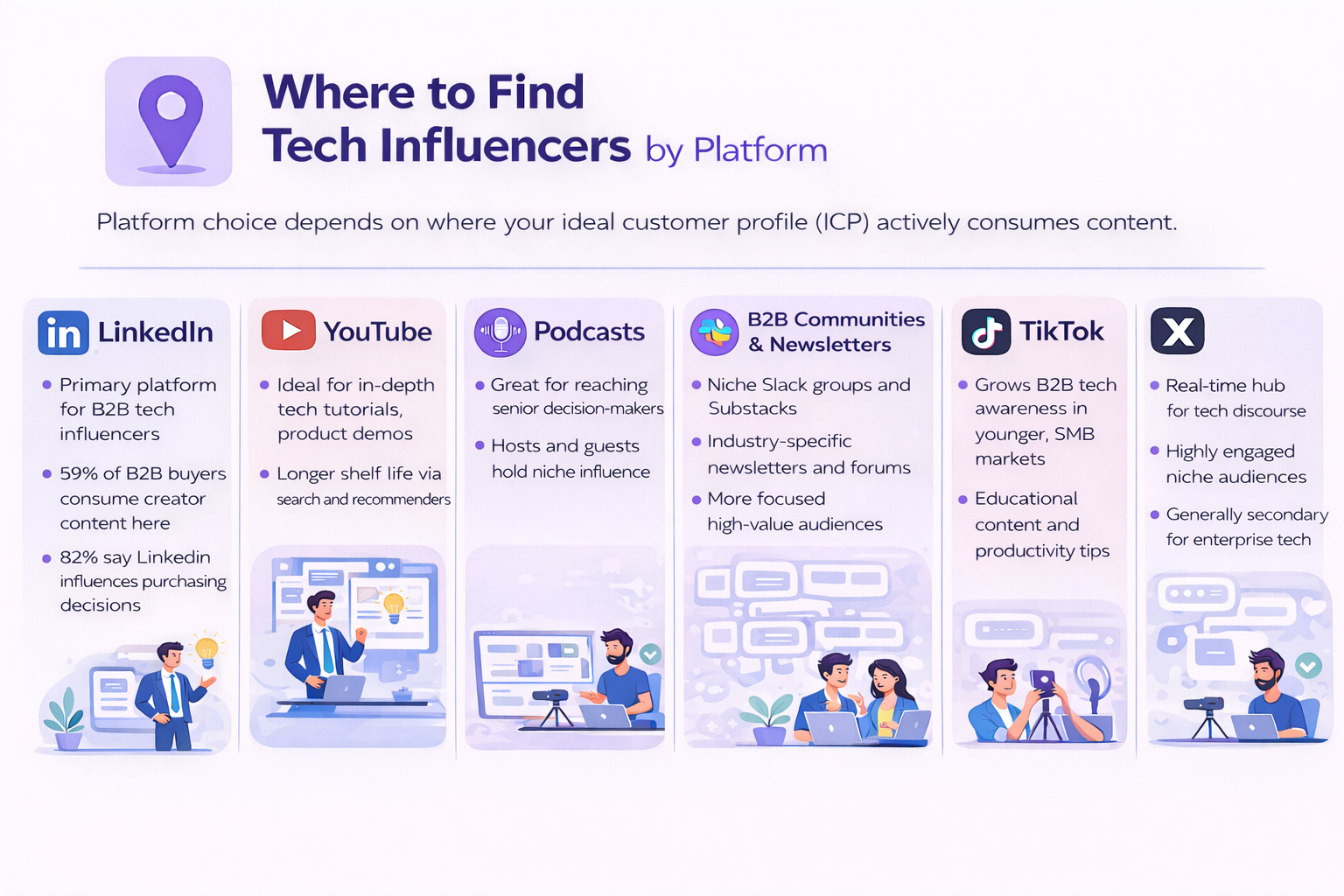
Platform choice depends on where your ICP actually consumes content. A creator's platform determines not just reach, but the type of engagement and audience intent you can expect.
LinkedIn remains a core platform for B2B tech creators reaching professional and enterprise audiences. Thought leadership posts, carousels, newsletters, and long-form articles perform well, and the audience is already in a business mindset.
LinkedIn newsletters have emerged as particularly effective for B2B influence, allowing creators to build subscriber lists and deliver consistent value directly to decision-makers' inboxes. For SaaS and enterprise technology brands, LinkedIn often delivers strong ICP alignment, particularly for mid-market and enterprise decision-makers.
YouTube
YouTube works for long-form tech content, tutorials, and product deep-dives. It serves both consumer and enterprise tech audiences, depending on the creator.
The platform's search functionality also means content has a longer shelf life than social posts.
X
X functions as the real-time hub for tech discourse, where developers, security professionals, and technical leaders share insights and commentary. The platform rewards expertise and direct engagement over production quality.
For B2B tech brands targeting technical audiences (DevOps engineers, security teams, developers), X often delivers highly engaged niche communities. Creators here typically have smaller followings but stronger influence within their specialisms.
TikTok
TikTok has carved out space for B2B tech content aimed at younger professionals and SMB decision-makers, though it remains secondary to LinkedIn and YouTube for enterprise campaigns. Educational content, productivity tips, and tool tutorials work when simplified for short-form video.
The platform suits brands targeting startups, small businesses, or building early awareness with future enterprise buyers. For traditional enterprise software, it remains secondary to LinkedIn and YouTube.
Podcasts
B2B podcasts reach senior decision-makers during commutes and focused listening time.
Podcast hosts and frequent guests often hold significant influence in their niches, even without massive social followings.
B2B Communities and Newsletters
Niche Slack communities, Substacks, and industry-specific publications host influential voices who operate outside mainstream social platforms.
If your ICP participates in specific professional communities, the influencers there can be more valuable than creators with larger general followings.
How to Find the Best Tech Influencer for Your Brand
Finding the right tech influencer follows a practical process. Skipping steps here typically leads to mismatched partnerships and wasted budget. The same principles apply beyond the tech niche; our guide on how to find the right B2B influencer for your brand walks through the wider process.
1. Define Your Target Audience and Ideal Customer Profile
Finding the right influencer starts with clarity on who you're trying to reach. Your ICP determines which creators matter. If you're targeting enterprise security teams, a creator who reaches startup founders won't move the needle, regardless of follower count.
2. Identify the Platforms Your Buyers Actually Use
Match platform to buyer behavior, not to where influencer marketing feels easiest. Where do your target buyers actually spend time? Where do they consume content related to their professional challenges?
3. Search for Creators with Relevant Subject Matter Expertise
Practical discovery methods include:
- Topic and keyword search: Use LinkedIn search and filters to find creators consistently publishing on SaaS, DevOps, Cybersecurity, and ICP-relevant topics.
- Engagement quality review: Look for creators driving thoughtful discussions among founders, operators, and decision-makers.
- Event and webinar speakers: Identify industry contributors who publish insights beyond the stage.
- Podcast and newsletter contributors: Frequent guests and niche writers often have built trust within specific verticals.
- Ecosystem analysis: Review partners, competitors, and adjacent SaaS brands to see which creators they work with.
4. Analyse Audience Composition and Decision-Maker Reach
A large audience means nothing if it doesn't include your target buyers.
Verify who actually follows a creator before engaging. Some creators share audience demographics; others require direct conversation.
5. Review Content Quality and Brand Alignment
Evaluate tone, production quality, values alignment, and past brand partnerships.
How does the creator handle sponsored content? Does their style match your brand? Have they worked with similar companies?
How to Evaluate Technology Influencers for B2B Campaigns
Once you've identified potential creators, vetting separates effective B2B influencer marketing partnerships from expensive mistakes.
Red flags to watch for:
- Low engagement relative to followers: May indicate purchased followers or inactive audience
- No enterprise brand partnerships: Could signal audience mismatch for B2B
- Generic content without expertise: Won't resonate with sophisticated buyers
Audience Overlap with Your ICP
Assess whether a creator's audience actually includes your target job titles, industries, and company sizes.
A creator might have impressive engagement, but if their followers are students and early-career professionals, they won't help you reach enterprise buyers.
Content Depth and Technical Credibility
B2B buyers detect inauthenticity quickly. Evaluate whether the creator has genuine expertise or surface-level knowledge.
Do they understand the problems your product solves? Can they speak credibly about technical topics?
Engagement Quality Over Follower Count
Comments and conversations reveal more than likes. Are decision-makers engaging with the content? Are the comments substantive or generic? High-quality engagement from the right people outweighs high-volume engagement from the wrong ones.
Track Record with Enterprise and B2B Brands
Review past partnerships to understand how the creator handles sponsored content. Have they worked with similar companies? How did those campaigns perform? Creators with B2B experience understand the nuances of enterprise messaging.
Top Technology Influencers by Category
Rather than listing names that become outdated, here's how to think about influencer categories across different verticals.
SaaS and Enterprise Software Influencers
SaaS influencers cover productivity tools, enterprise software, and business applications. They typically operate on LinkedIn and YouTube, reaching product managers, operations leaders, and IT decision-makers. Their content often focuses on workflows, tool comparisons, and implementation guidance.
Cybersecurity and Information Security Influencers
Security-focused creators reach CISOs, security engineers, and IT leaders responsible for protecting organisations. This niche has strong communities on X, LinkedIn, and specialised podcasts. Credibility here requires genuine technical expertise.
AI and Machine Learning Influencers
AI-focused creators reach both technical and business audiences interested in practical AI applications. This category has grown rapidly, with creators ranging from researchers to business strategists. The audience includes CTOs, data science leaders, and executives evaluating AI investments.
DevOps and Developer Relations Influencers
Creators focused on developer tools, infrastructure, and technical implementation topics reach engineering leaders and practitioners. They often have strong presences on X, YouTube, and developer communities. Authenticity is particularly important here, as developers are notoriously sceptical of marketing.
Consumer Tech and Gadget Reviewers
For completeness: consumer tech reviewers are the "top tech influencers" most people think of, but they're least relevant for B2B enterprise campaigns. Their audiences are consumers, not enterprise buyers.
Notable B2B Tech Influencers to Study
Rather than providing an exhaustive list that quickly becomes outdated, here are examples of B2B tech influencers worth studying to understand what effective B2B influence looks like:
SaaS & GTM
Chris Walker (Refine Labs), Kyle Poyar (OpenView Partners), Elena Verna (Amplitude): discuss go-to-market strategy, product-led growth, and B2B sales
DevOps & Infrastructure
Kelsey Hightower (Google Cloud), Charity Majors (Honeycomb), Corey Quinn (Duckbill Group): reach engineering leaders and technical decision-makers
Cybersecurity
Brian Krebs (KrebsOnSecurity), Troy Hunt (Have I Been Pwned), Katie Moussouris: influence CISOs and security professionals
AI & Data
Cassie Kozyrkov (Google), Chip Huyen, Andrew Ng: reach data science leaders and AI decision-makers
These creators demonstrate what authentic B2B influence looks like: deep expertise, consistent value delivery, and audiences composed of actual decision-makers rather than general consumers.
Common Mistakes When Searching for Tech Influencers
63% of tech buyers now trust social video content from industry experts when making purchasing decisions (Cherry Lane Media, 2025).
B2B brands typically encounter predictable pitfalls. Avoiding them saves budget and frustration.
Prioritising Follower Count Over Audience Relevance
Large audiences often mean diluted relevance for B2B campaigns targeting specific decision-makers. A creator with 2 million followers might have 0.1% overlap with your ICP. A creator with 15,000 followers might have 40% overlap.
Using Consumer Influencer Platforms for B2B Goals
Consumer influencer marketplaces optimise for reach, not ICP targeting. They work well for brands selling to general consumers. They work poorly for brands targeting enterprise buying committees.
Skipping Thorough Creator Vetting
Insufficient due diligence leads to brand misalignment, audience mismatch, and poor content quality. Vetting takes time, but the cost of a failed partnership, both in budget and brand reputation, exceeds the cost of thorough evaluation.
Why B2B Brands Partner with Specialised Tech Influencer Agencies
Managing multi-creator campaigns involves operational complexity that compounds quickly: contracts, compliance, creator communication, content review, payment logistics, and performance tracking across multiple partnerships simultaneously.
Self-serve platforms offer scale but leave strategy, vetting, and execution to you. For brands that need precision over scale, agencies like Flooencer handle custom sourcing, creator management, contracts, compliance, and performance tracking.
We've worked with 25+ publicly traded brands, managing a roster of 2,000+ vetted business creators across LinkedIn and niche B2B communities.
The trade-off is straightforward: managed services cost more than self-serve platforms, but deliver higher ICP match rates and remove operational burden from your team. For a detailed breakdown of what each model costs, see our complete guide to B2B influencer campaign costs.
Book a call to discuss your business influencer marketing campaign.
Commonly asked questions from this article
The distinction comes down to audience, not follower count. A consumer tech influencer reviews gadgets and reaches general consumers, whilst a B2B tech influencer speaks directly to enterprise decision-makers evaluating software, infrastructure, or business tools. Focus on:
- Audience composition: B2B creators reach CTOs, IT directors, and buying committees, not general consumers
- Platform focus: B2B influence primarily lives on LinkedIn, podcasts, and niche communities rather than YouTube or Instagram
- Content depth: B2B creators discuss implementation, ROI, and organisational impact, not unboxings or consumer reviews
- Credibility signals: Prior industry roles, speaking engagements, or published expertise matter far more than aesthetics
B2B tech influencer rates vary significantly based on audience quality, content format, and exclusivity, and they run higher than consumer influencer rates for the same follower counts. Typical ranges include:
- Nano-influencers (1K–10K followers): $50–$500 per post
- Micro-influencers (10K–50K followers): $200–$1,500 per post: the sweet spot for most B2B campaigns
- Macro-influencers (50K–250K followers): $1,200–$7,500 per post
- Industry thought leaders: $2,500–$15,000+ per deliverable
- For a meaningful pilot campaign, budget $15,000–$25,000 to engage 3–5 creators with production and measurement infrastructure
Start with your ICP, not a creator database. The most effective B2B tech influencer discovery follows a specific process rather than broad searches. Key steps include:
- Conference speakers: Industry event presenters have built audiences around proven expertise
- Podcast guests: Frequent guests on relevant podcasts hold established credibility with your buyers
- LinkedIn content search: Search topics your ICP cares about and identify who creates the content they engage with
- Competitor partnerships: Identify which creators your competitors have worked with and assess audience overlap
- Prioritise audience-ICP alignment over follower count. A creator with 8,000 followers reaching enterprise CFOs outperforms one with 80,000 scattered followers
B2B influencer campaigns run on longer timelines than consumer campaigns due to extended sales cycles and committee-based buying decisions. Realistic expectations by timeframe:
- Weeks 1–2: Engagement metrics visible, impressions, clicks, content reach
- 30–90 days: Pipeline influence begins to materialise, qualified leads appear
- 3–6 months: Full pipeline attribution becomes measurable given typical B2B sales cycles
- Always-on programmes dramatically outperform one-off campaigns, 99% of B2B marketers using an always-on approach rate their programmes as effective (TopRank Marketing, 2025), compared to campaign-based teams who are 17 times more likely to report ineffectiveness
Poor vetting is the most common reason B2B influencer campaigns underperform. A creator may look credible on the surface but fail to deliver ICP reach or genuine expertise. Watch for:
- Low engagement relative to followers: Often signals purchased followers or an inactive audience
- Generic content without depth: Sophisticated B2B buyers detect surface-level knowledge quickly and disengage
- Inconsistent or unverifiable credentials: Claims of deep expertise without traceable proof, past roles, published work, or speaking engagements signal inflated authority that sophisticated B2B buyers will see through immediately
- Audience composition misalignment: Impressive engagement rates mean nothing if followers are students, early-career professionals, or outside your target industry. Always verify job titles and seniority before committing budget
Read more

26 Feb 2026
Business Influencer Marketing KPIs: A Complete Guide
Key influencer marketing KPIs to measure performance, ROI, and business impact.

26 Feb 2026
Top Influencer Marketing Platforms to Grow Business in 2026
Details on all the latest influencer marketing platforms in 2026 to compare which is the right fit for your business.

26 Feb 2026
How to Find the Right B2B Influencer for Your Brand
Learn how to find and vet B2B influencers who match your brand values, audience, and goals. Discover the key criteria that drive real marketing results.